


Breeders’ Cup Fantastic Finishes: A Nail-Biter of a Coronation
Four years ago, Joel Funk walked into his first yearling sale at Keeneland and saw nearly $400 million change hands in less than two weeks. Billionaires, celebrities, and global power brokers gathered in Lexington, Ky., bidding on bloodstock. When others were talking recession, Funk was talking opportunity.
“I was just blown away,” Funk said. “You want to get the wealthiest people in the world in a room, have a horse sale.”
The experience crystallized an idea that had been forming since childhood trips to Arlington Park. Funk loved the sport but found traditional ownership restrictive, capital-intensive, illiquid, and largely inaccessible to everyday fans. After pitching his wife on buying a racehorse — “She said, ‘We’re not buying a horse’ ” — Funk began thinking differently.
“I started thinking about a horse more like the lifecycle of a company on the stock market,” he said. “You’ve got the initial offering – the entry point – followed by ongoing performance, results, earnings, media coverage, and public interest that shape how the company is viewed and valued over time. That perception can rise or fall based on performance. A horse’s career works in a similar way – race results, purse earnings, and public attention shape how a horse is perceived and followed through its career.”
That thought experiment became MORNINGLINE.IO, a regulated platform designed to allow investors to purchase and trade securities tied to racehorses. It combines elements of equity markets, sports ownership, and Thoroughbred racing.
At its core, MORNINGLINE.IO structures interests in horses as securities offerings. Each horse listed on the platform is divided into 50,000 digital shares. If the company offers 10% of a horse, 5,000 shares are made available to investors. The simple math is 1% equals 500 shares. The total share count remains fixed.
 Learn more about MORNINGLINE.IO
Investors may participate in primary offerings and, subject to platform rules and applicable securities regulations, trade shares on a secondary marketplace. The company currently operates under Regulation D exemptions and has indicated it is working toward Regulation CF offerings to broaden access to non-accredited investors.
“It’s fully regulated,” Funk said. “We’re building it so everyday investors can participate – expanding access beyond a small group of high-net-worth individuals.”
Shareholders may receive dividends tied to the offered ownership interest, meaning allocations from purse earnings and, where applicable, future sale, breeding or insurance proceeds, as outlined in the offering documents. Dividends are not guaranteed. Racehorses remain speculative assets subject to performance risk, health considerations, market demand, and regulatory constraints. Prospective investors are encouraged to review all disclosures carefully.
Still, the framework is intuitive for anyone familiar with equities. A strong performance on the track can enhance perceived value, while a disappointing effort may dampen it. Unlike a pari-mutuel wager, where capital is committed to a single race outcome, participation on MORNINGLINE.IO allows financial exposure to span a horse’s entire career from the racetrack to the breeding shed.
“We’re creating a new category,” Funk said, “shifting betting behavior from short-term wagering into long-term ownership and a portfolio mindset.”
Platform transaction fees are 3% on purchases and 3% on secondary sales.
MORNINGLINE.IO targets a layered audience. Retail investors seeking alternative assets represent one segment. Racing enthusiasts, especially those drawn in by marquee events like the Kentucky Derby, represent another.
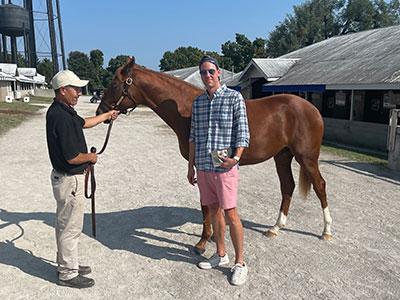
“It’s amazing how many people don’t follow racing every day, but you talk about the [Kentucky] Derby, and they’re all about it,” Funk said. “There are a lot of people who want that owner experience and never thought they could.”
The platform may also resonate with seasoned handicappers accustomed to thinking in probabilities and risk-reward scenarios.
“[Horseplayers] already think like traders,” Funk said. “They understand performance changes. They understand bankroll allocation.”
MORNINGLINE.IO plans in the near future to incorporate a loyalty component through what it calls MLine Coin. The coins are not equity securities but expected to function as a rewards mechanism tied to platform participation. They may be redeemed for racing-related experiences, such as paddock access or event tickets, subject to company terms and availability.
On the supply side, MORNINGLINE.IO positions itself as a capital-management tool for owners and trainers. By listing a portion of a horse’s ownership, connections can potentially raise capital, diversify exposure, and introduce liquidity into what has historically been an illiquid asset class.
MORNINGLINE.IO’s racehorse evaluation process is anchored by co-founder Tom Taaffe, a longtime Thoroughbred industry professional with experience spanning training, bloodstock evaluation, and international racing.

According to the company’s materials, Taaffe helps identify prospects that meet defined quality and performance standards before they are structured into offerings on the platform. The evaluation criteria emphasize pedigree strength, physical conformation and athleticism, and competitive potential, whether a horse is already racing or positioned for a breakout campaign.
Rather than operating as an open marketplace where anyone can list assets, MORNINGLINE.IO sources and selects the horses offered on its platform. The company acquires assets directly or partners with established owners and trainers to list partial interests in horses already in training. Current partners include Kentucky Derby and Kentucky Oaks winning trainer Kenny McPeek and racing partnerships such as Hard Knocks Racing and Ocean Reef Racing, and the company continues to seek relationships with owners interested in listing horses on the platform.
The model blends traditional bloodstock judgment with a structured securities framework to bring racetrack intuition and market architecture together.
In some ways, the concept mirrors platforms like Masterworks, which opened fractional ownership of fine art to retail investors. The difference, though, is that a Thoroughbred runs every few weeks, and its value can shift in real time on the racetrack.
Several horses on the platform are positioned along the road to the Triple Crown, adding narrative appeal. Exposure to a Derby trail contender, even at a modest ownership percentage, carries emotional resonance rarely found in traditional alternative assets.
The company has also structured a high-profile offering tied to 2024 Horse of the Year Thorpedo Anna. The arrangement allows investors to participate economically in a portion of her future breeding career, subject to offering terms. Shareholders could benefit from proceeds generated by her offspring over time, though breeding performance and commercial demand remain uncertain.
“It’s pretty incredible,” Funk said. “When you buy a share, you’re gaining exposure to her [Thorpedo Anna’s] entire bloodline, future legacy, and the long-term value that could come from what might be one of the greatest mares in racing.”
For now, MORNINGLINE.IO remains focused on Thoroughbred racing, though its platform architecture could extend to other sports-related assets in the future.
Whether it ultimately reshapes ownership in racing will depend on adoption, regulatory execution, and market discipline. But the idea of capturing race-to-race value and allowing it to trade in a structured marketplace aligns with broader trends in alternative investing and fan engagement.
Standing in that Keeneland sales pavilion years ago, Funk saw more than hammer prices. He saw a market.
“I kept asking myself, ‘Why hasn’t anyone tried to do this?’” he recalled. “I’m going to capture the value created race by race and give people the ability to participate in it. And that’s literally how this idea came about.”