

Pleasant Colony: The Late-Blooming Derby Winner Who Silenced the Doubters
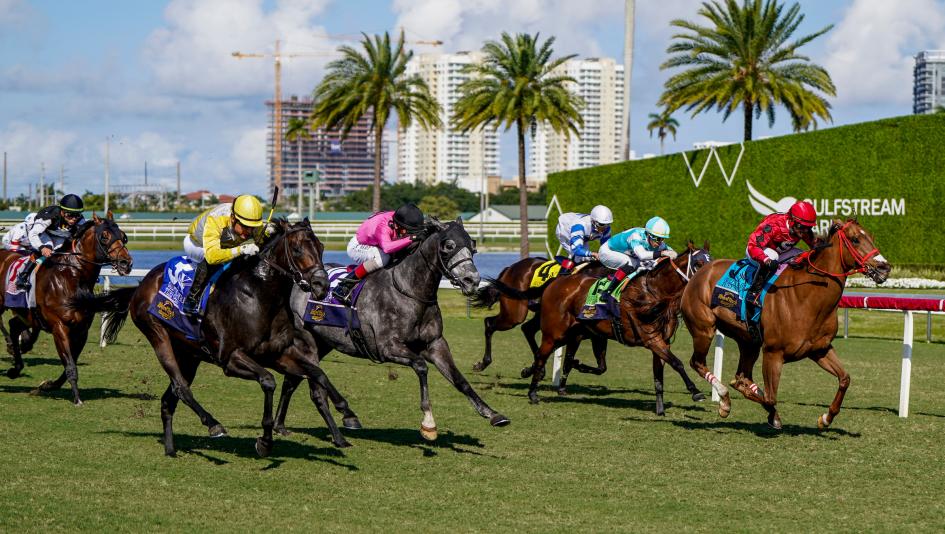
The Gulfstream Park Championship Meet will bring together the best horses, trainers, jockeys, and stakes action that horseplayers can find during the winter months. It will be tops amongst the must-see race meets for racing fans, handicappers, and horseplayers for the entire four-month season.
The 2026-‘27 Gulfstream Park Championship Meet begins on Thanksgiving Day, Nov. 26 and will continue on a four-day a week schedule, Thursdays through Sundays, until March 28. A couple of Gulfstream’s premier days will be Pegasus World Cup Day, with seven graded stakes races on Jan. 30, and Florida Derby Day featuring five graded stakes races on March 27.
Gulfstream Park racing is conducted on three surfaces: its traditional dirt main track, a wide turf course that can be divided into inner and outer lanes, and a Tapeta all-weather track that also handles off-the-turf races. The season customarily begins with horses shipping to Florida from all over the East and Midwest to join the cream of the crop of the local south Florida contingent. When the calendar reaches early January is when you really notice Gulfstream’s quality of racing jump up a notch at the Championship Meet to the highest levels of racing and wagering in Florida all year through the January-February-March portion of the season.
Gulfstream Park Leading Trainers
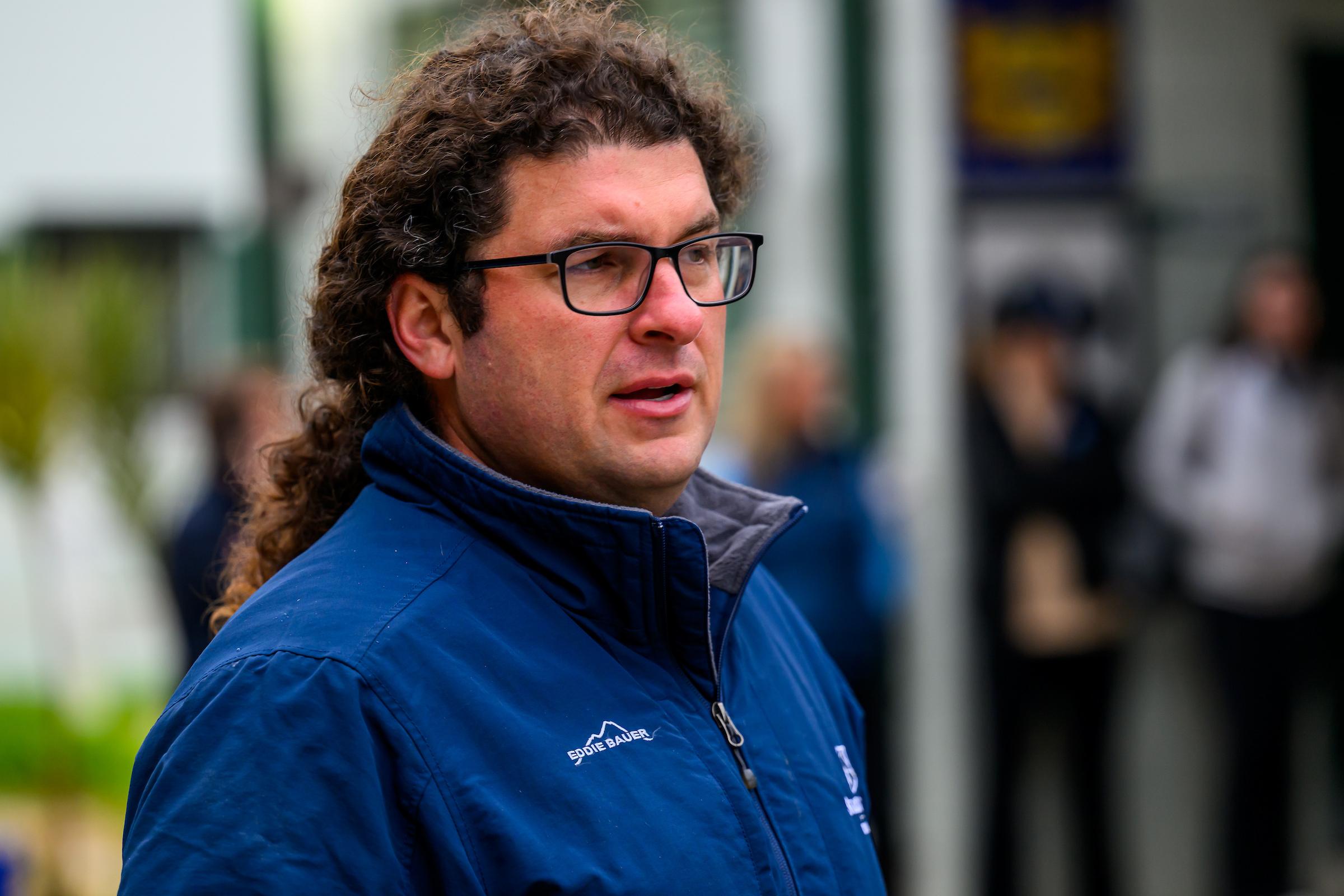 Saffie Joseph Jr. (Eclipse Sportswire)
Saffie Joseph Jr. scored another Gulfstream Park training title at last year’s Championship Meet when he won 45 races from 255 starters for 18%. That total looks big, but it was actually down from two years ago when Joseph ran away with the winter training title with 70 wins from 353 starters for 20%. Expect another meet training title from Joseph again in 2026-‘27.
Mark Casse had an impactful Championship season last year to finish the meet second among all trainers with 32 wins and a 16% win rate with a lot of turf horses and all-weather track specialists who come down from Woodbine. Carlos David, a locally based trainer who also does a lot of his winning at this meet on the all-weather surface, finished third in the 2025-‘26 standings with 29 wins (22%). Brian Lynch was among the best trainers to bet at last year’s meet in terms of ROI and winning percentage. He finished fourth in the standings with 27 winners from just 96 starters for 28%. Jose D’Angelo, who had finished second in the standings two years with 40 winners from 196 starters (20%) at the 2024-‘25 meet, finished fifth on last year’s leaderboard with 25 wins (13%).
The next tier of winningest Gulfstream Championship Meet trainers is led by some of the top names in the game such as Brad Cox, Bill Mott, and Todd Pletcher, who will all have winter strings at Gulfstream. Cox dedicated more of his stable to south Florida last year and finished sixth on the Championship Meet leaderboard with an excellent player-friendly 32% winning percentage with based on a record of 21 wins from 65 starters. Mott went 20-for-104 (19%) last season after compiling 14 wins from 100 starters the year before, and Pletcher sent out 18 winners from 135 starters last year for 13% which was actually a drastic reduction in productivity at the meet for Pletcher after his barn had 31 victories (17%) two years ago and when he was the second-leading trainer at the meet three and four years ago when he won 37 and 41 races, respectively.
Other trainers capable of vying for spots in the top 10 on the Gulfstream winter trainer leaderboard include Victor Barboza Jr., who had 21 wins for 17% last year after putting up 27 wins for 23% two years ago, and Rohan Crichton (19 wins, 27% at the 2025-26 meet). More high percentage winners at last year’s meet included Brendan Walsh (17 wins, 21%), David Fawkes (16 wins, 22%), Jorge Delgado (15 wins, 23%), Mike Maker (11 wins, 16%), and Graham Motion (nine wins, 23%). Chad Brown was also present with nine wins from 52 starters for 17% after recording eight wins for 13% two years ago.
Gulfstream’s Top Jockeys
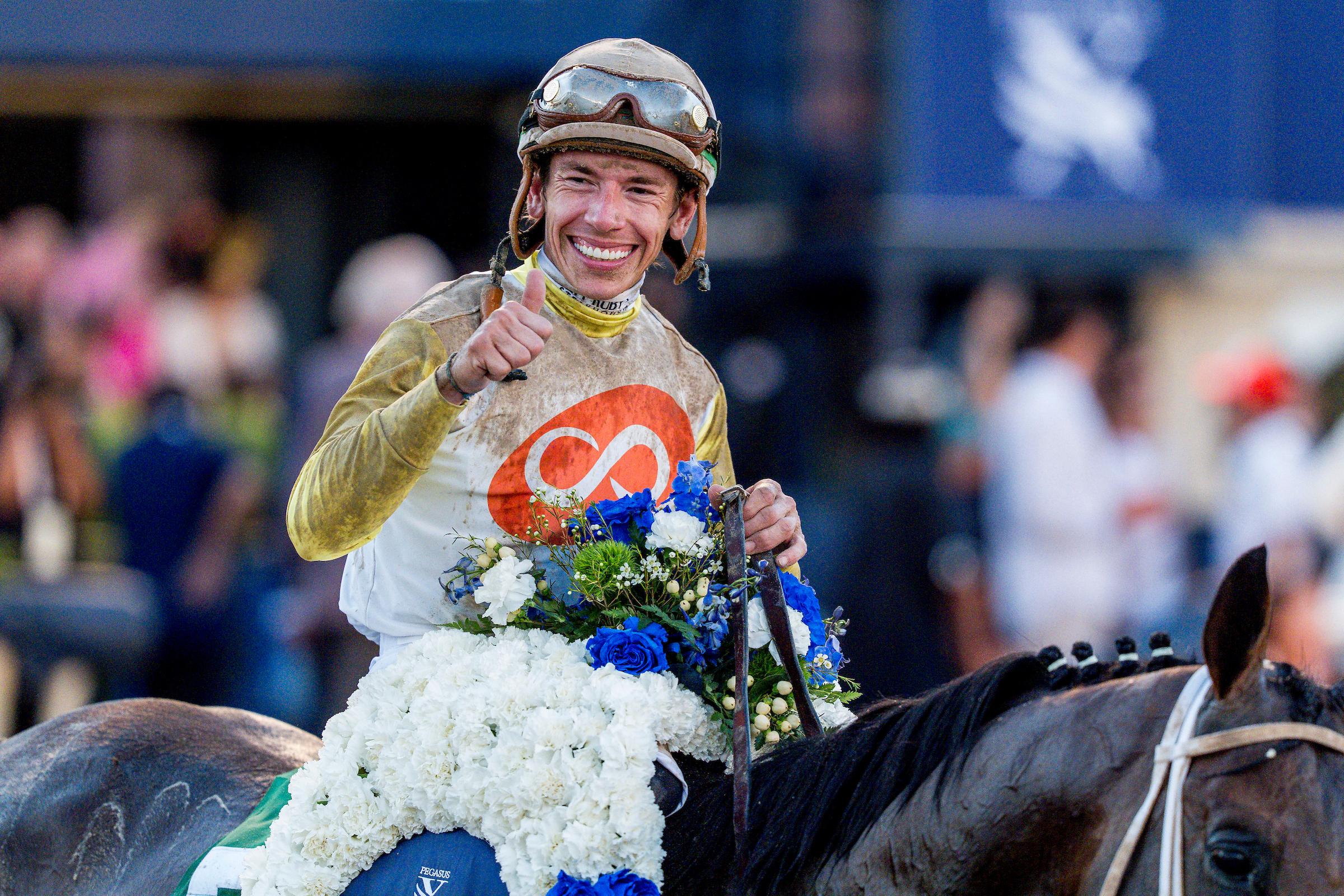 Tyler Gaffalione (Eclipse Sportswire)
A premier jockey colony will be based at Gulfstream for the Championship season. The leading jockey at last year’s corresponding Championship Meet was Irad Ortiz Jr., who rode 82 winners from 312 mounts for 26%. How Irad will do this season will depend on his progress returning from a broken ankle that he suffered in a fall on Oct. 22 at Keeneland. If healthy, Irad is fully established as the big cheese in the Gulfstream Championship Meet jock’s room. In addition to winning last year’s jockey title, he also won in 2024-‘25 with 109 winners from 450 mounts for 24%, in 2023-24 with 119 wins from 526 mounts (23%), and 2022-‘23 when he won 128 races from 454 mounts (28%).
If Irad Ortiz misses part of the meet, last year’s runner-up in wins, Tyler Gaffalione, has a chance to assume the throne in 2026-’27. Gaffalione had 68 wins from 436 mounts for 16% a year ago. Another big threat to take home the riding crown is Flavien Prat. The reigning two-time Eclipse Award winner raced on occasion at Gulfstream last winter but also spent much time at the now-closed Aqueduct in New York. He’ll be based at Gulfstream for the upcoming Championship Meet.
Other jockeys that are strong candidates to finish in the top 10 in the standings this season include Edgard Zayas (54 wins for 16% at last year’s meet), Javier Castellano (50 wins, 17%), Miguel Angel Vasquez (42 wins, 13%), Junior Alvarado (38 wins, 15%), Jorge Ruiz (38 wins, 13%), John Velazquez (36 wins, 17%), Edwin Gonzalez (33 wins, 16%), and Jose Morelos (32 wins, 10%). Also, keep an eye out for Micah Husbands, who arrived to ride at Gulfstream in fall of 2025 and proceeded to win 27 of his 176 mounts at last season’s meet for 15% while establishing a rapport with leading trainer Saffie Joseph that will continue to assure him of more live mounts this season.
Gulfstream Dirt Track Sprint Trends
The prevailing running style preference in Gulfstream dirt races favors horses with early speed, or at least tactical speed, at all distances. Deep closers don’t do well on this main track, especially in dirt sprints, and that was on full display at last season’s 2025- ‘26 Championship Meet when closers fared poorly and burned a lot of money. Closers – as defined for this article as horses coming from four lengths or more off the lead – were bad bets at the corresponding winter meet last year, winning a paltry 11 of the 154 dirt sprints ranging from five furlongs to 7 ½ furlongs to account for only 7% of the wins. Meanwhile, speed horses on or close to the pace – as defined for this article as racing on the lead or within one length of the pace – won 79 of the 154 dirt sprints to account for 51% of the races. Stalkers racing between one and four lengths off the pace won 64 of the 154 dirt sprints (for 36%). There appeared to be no meaningful post position bias or favoritism for inside, middle, or outside posts.
Dirt Mile and Route Preferences
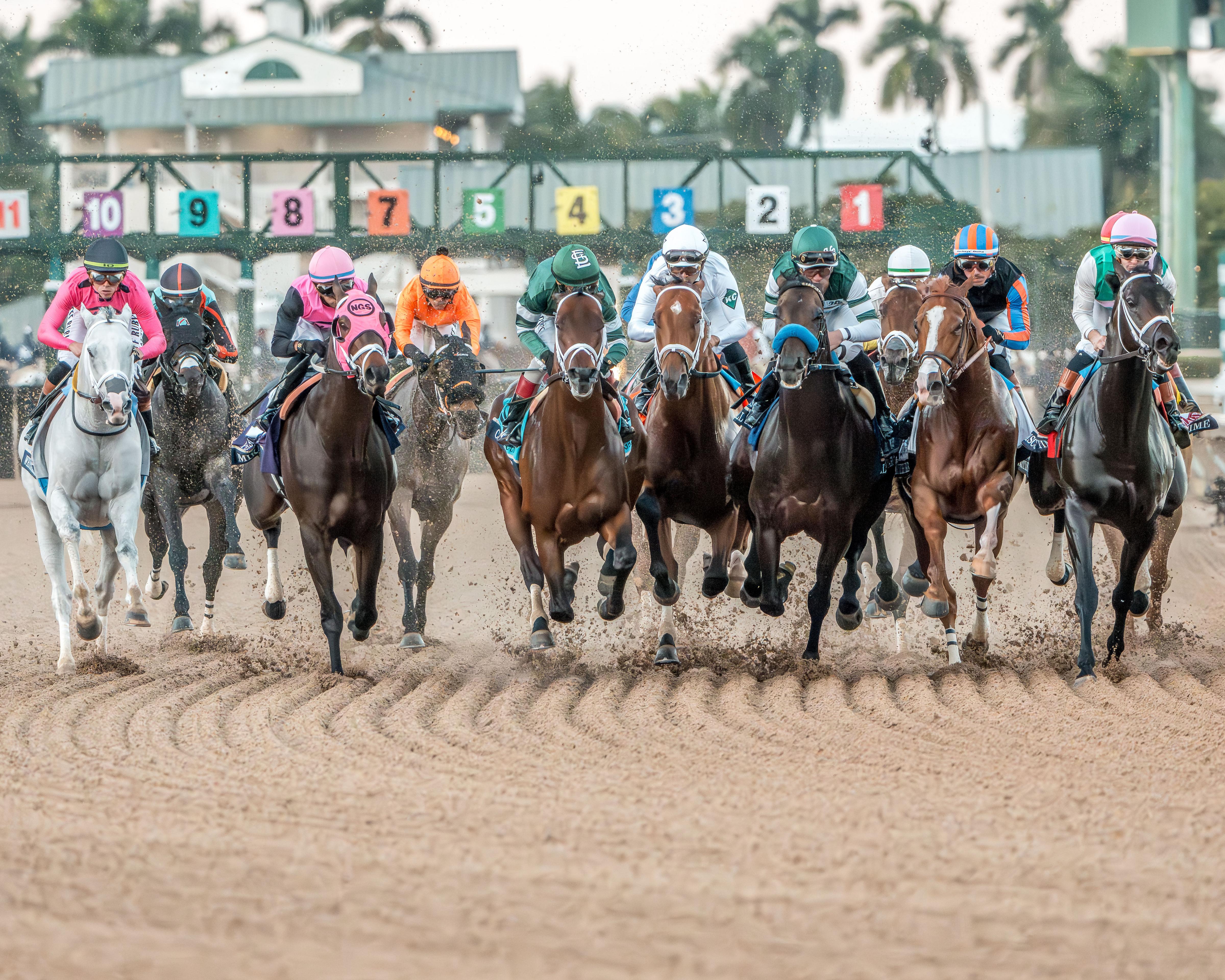 Route racing at Gulfstream. (Eclipse Sportswire)
Gulfstream dirt mile races are run around one turn and are often more like long sprints than routes. The front-end advantage that exists in sprints still results in an anti-closers bias in a big way at the one-mile distance. Closers almost never win the dirt mile races run at the Championship Meet. Last year, there were 61 such races run during the season and closers shockingly won only five of them to account for just 8%. Horses on or close to the lead did great with wins in 33 of the 61 races for 54% of the total. Stalkers won 23 of the 61 dirt miles for 38%.
Taking a deeper dive into these stats, we can notice that the vast majority of the winning stalkers at the meet at a mile broke from the inside posts 1-3. Of the 23 staking winners, 17 broke from the inside posts while three broke from middle posts and three broke from outside posts. The post positions overall played fairly at a mile for inside, middle, and outside posts, except for stalkers, who had by far their best success from the inside.
Gulfstream two-turn dirt routes are mostly run at the distances of 1 1/16 miles and 1 1/8 miles, but those races are becoming less and less frequent with only four races run at 1 1/8 miles and 19 races run at 1 1/16 miles during last year’s Championship season. The biggest trend for handicapping two-turn dirt routes at these distances at Gulfstream – both long-term and short term specifically at last year’s meet – favors the inside posts and inside running paths. Bet against anything outside post position 5. Horses breaking from posts 1-3 won 12 of the 23 routes run at 1 1/16 miles and 1 1/8 miles at last year’s meet to account for 52% of the winners. There were two winners from outside post 6. In terms of running styles, again, there was a strong anti-closers bias at 1 1/16 miles just as there was in dirt sprints and miles. Just one of the 19 races at that distance were won by a closer at last year’s meet.
Gulfstream Park Turf Tips
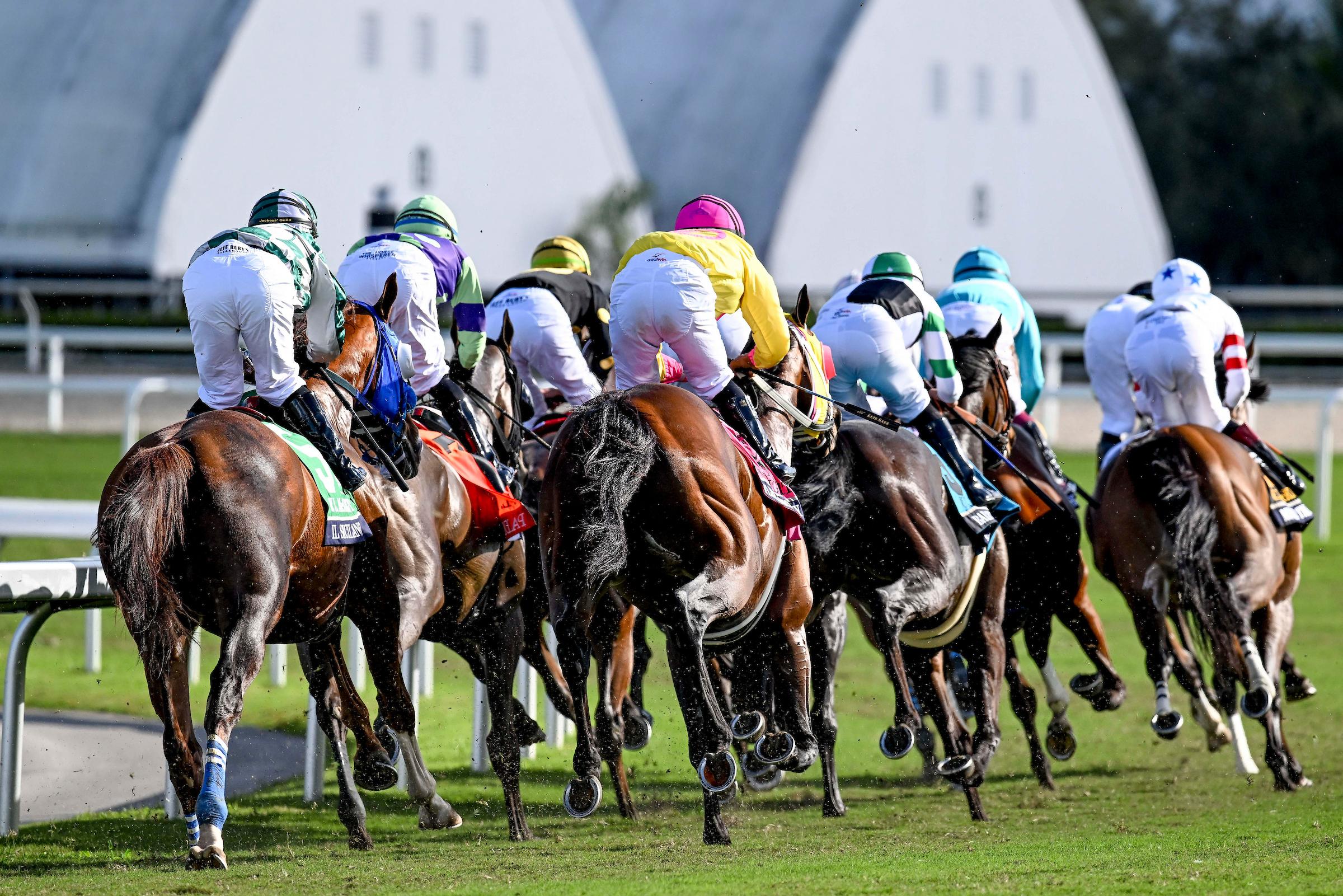 Competitive turf racing. (Eclipse Sportswire)
A large part of the winter action at the Gulfstream Park Championship Meet takes place on the grass with the track hosting much of the country’s best turf racing during the winter season.
Turf handicappers generally are accustomed to downgrading outside post positions in turf routes at most tracks, but the long-term stats for Gulfstream Park turf routes show very little advantage or disadvantage to either inside or outside posts at Gulfstream. Don’t shy away from a contender if your horse draws post 9 or 10 or 11 or 12, because horses from those posts can win from way outside at Gulfstream.
When searching for the preferred running style in turf routes, it is stalkers that tend to do the best. Through the years, Gulfstream’s turf course has been considered by many handicappers to be a place where it is difficult to win going wire-to-wire, especially when the turf rails are close to the hedge (Gulfstream announces the position of the turf rails before every racing day). At last year’s Championship Meet, horses on or close to the lead did much better than usual when winning 49 of the 154 turf routes to account for 32% of the winners. Just because there’s a bias against front-runners, however, does not mean that closers do any better. As a matter of fact, at last year’s meet, they did worse. Closers actually had the least successful running style in turf routes with 33 wins in the 154 races to account for 21%. The big winners in Gulfstream turf routes statistically are the stalkers. At last year’s corresponding season, stalkers coming from between one and four lengths off the pace won 72 of the 154 turf routes to account for 47%.
Bet Speed in Turf Sprints
Gulfstream Park’s turf sprints are all run at five furlongs, not counting occasional 7 ½-furlong races, which are held around two turns and aren’t included in accurate turf sprint stats. The name of the game in Gulfstream five-furlong turf sprints is speed. The turf dashes are often dominated by horses on or close to the early lead, and stats from last year’s Championship Meet are no exception. Front-runners won 24 of the 43 turf sprints run the past year to account for 56%. In particular, inside speed from posts 1-3 is often the deadliest combination of running style and post position. Most of the races not won by speedsters are won by up-close stalkers. The stalkers won 33% of the turf sprints at last year’s meet. You really don’t want to bet closers in these races. There were only five winning closers in the 43 turf sprints at last year’s Championship Meet for 12%.
Gulfstream Tapeta Trends
The Gulfstream Park Tapeta all-weather surface has become a major part of handicapping at the winter meet. Sprints are run at five furlongs and 5 ½ furlongs. The most common distance for routes is 1 mile and 70 yards. These surfaces are the backbone of year-round racing at Gulfstream and seem to become more and more prominent at the winter meet each year.
Just like in Gulfstream’s turf dashes, speed is king in Tapeta track sprints at Gulfstream at both five and 5 ½ furlongs. Gulfstream ran 137 Tapeta sprints during last season’s Championship Meet, and horses on or close to the lead won 59% of them. This statistic was consistent with all Tapeta sprints run the entire previous year. Closers, meanwhile, are an awful bet in Gulfstream’s Tapeta sprints, winning just 9% of the 137 races at the corresponding meet last season. The rest of the winners were stalkers. Post positions showed no favoritism between inside, middle, and outside starting gates.
Tapeta route races have mostly played fair over the course of the last year, both in terms of running styles and post positions. Closers were at a disadvantage, but not to the same degree as they were in sprints. From a sample of 144 Tapeta routes run at last year’s Championship season, post positions were mostly inconsequential for handicappers. The running style stats were fine for speed horses, who won 54 of the 144 routes (38% of the races), and stalkers, who won 58 times (40%), but closers struggled and won just 33 of the 144 Tapeta routes for 23% (note there was one dead heat for win). Often the best time to bet speed on all-weather tracks is in wet conditions, but unfortunately wet Tapeta is not a track condition notated in result charts or past performances.
We wish you a great Gulfstream Park Championship Meet. Good luck and enjoy the best of winter racing in South Florida!