

Noel’s Weekend Winners: Spotlight on Stakes Sprints on Pennsylvania Derby Day

For more than a century, Aqueduct Racetrack has been a part of Rockaway Boulevard in Jamaica, N.Y. In its earliest iteration, it was a dirt oval cut out of farmland with crops still flourishing in the infield and a shaky wooden grandstand for a few hundred fans. Over the century since, the Big A has been built on speedy shows by horses at all levels, the memories of these great performances woven into the fabric of both the grass and the dirt that make up its racing surfaces.
Out of the thousands of races the Big A has seen, these five stand out as the GOATs, the ones that have left an indelible impression on the sport for decades.
By 1964, Kelso was already a legend, and he still had more racing ahead of him over the next two seasons. He had won the Jockey Club Gold Cup and Horse of the Year four times, among his many wins and awards, and had become the third horse to complete New York’s Handicap Triple Crown. But in 1964, he encountered a spoiler named Gun Bow.
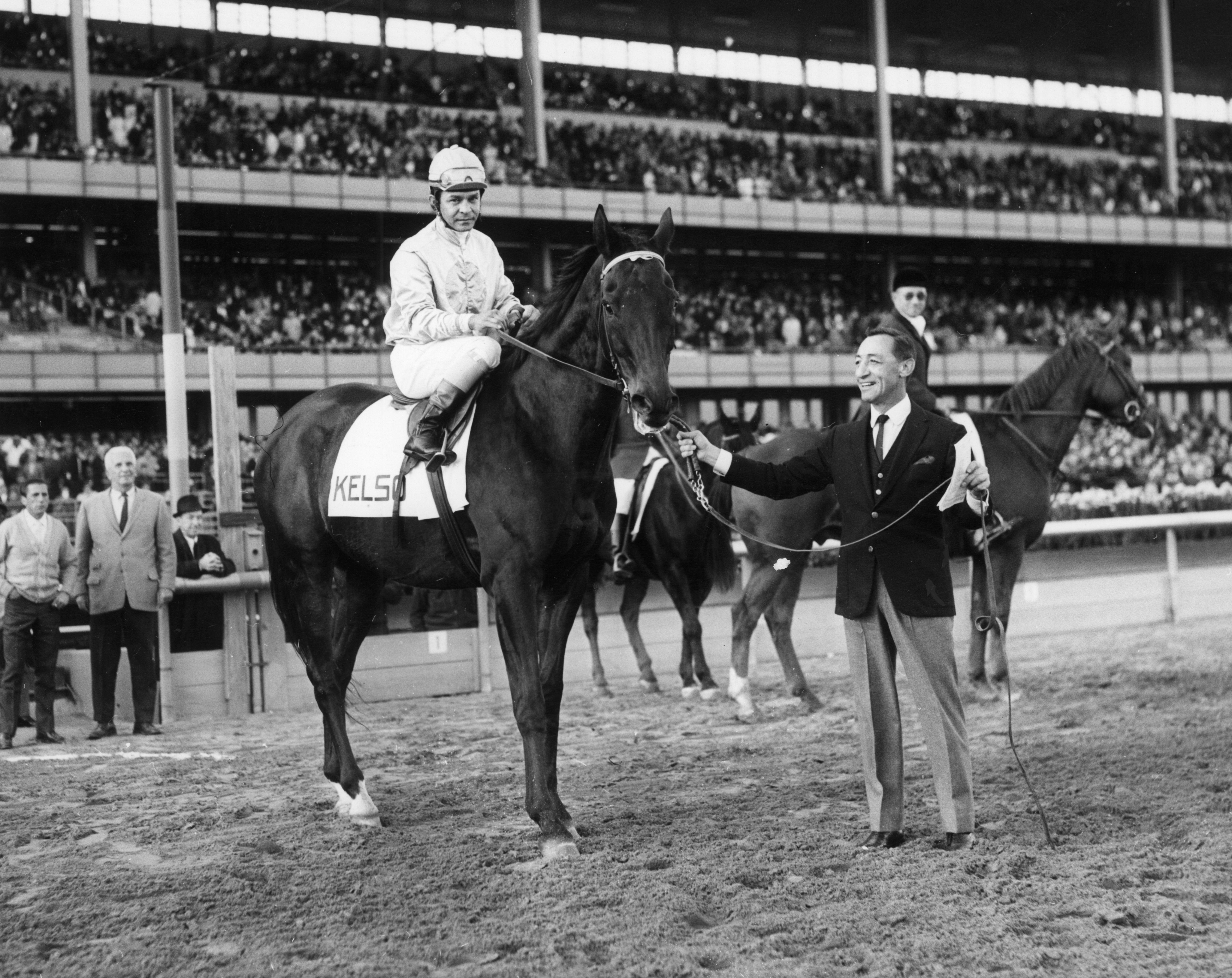
Unraced because of soundness issues at 2, Gun Bow won the Narragansett Special Handicap by 13 lengths at age 3 and then shipped west to California after his December 1963 purchase by Harry Albert and Mrs. John T. Stanley, who raced the colt under the name of Gedney Farm. He won a division of the San Fernando Stakes, the Charles H. Strub Stakes, and the San Antonio Handicap at Santa Anita in January and February 1964 before coming back east in March. He first faced Kelso in the Monmouth Handicap at New Jersey’s Monmouth Park.
There, Mongo got the best of both horses, taking the 1 ¼-mile feature by a neck over Kelso, with Gun Bow third. They met again in the Brooklyn Handicap a week later at Aqueduct, where Gun Bow dominated by 12 lengths while Kelso finished fifth. Five weeks later, they were back in the gate for the Aqueduct Handicap, where Kelso got the victory by three-quarters of a length from Gun Bow. That set up the showdown in the Woodward Stakes, again at Aqueduct.
Kelso had already won the 1 ¼-mile Woodward three times and was going for his fourth consecutive victory in the prestigious race. Gun Bow was looking to get the better of Allaire du Pont’s iconic star. Kelso had regular rider Milo Valenzuela in the saddle while Gun Bow and Walter Blum were back for another turn around the Big A. Alongside these two were Quadrangle, the Belmont Stakes winner who spoiled Northern Dancer’s 1964 Triple Crown bid; stakes-placed Guadalcanal; and South African star Colorado King.
Blum had Gun Bow on the lead from the break, with Valenzuela and Kelso tracking in second. The du Pont gelding waited for the far turn to make his move and took a short lead coming into the stretch while Quadrangle ranged up on the rail, threatening to pass the older pair. Kelso and Gun Bow picked up the pace and left the 3-year-old in their wake, battling head-to-head through the last furlong. Kelso lugged in as if he wanted to crowd Gun Bow, leaving Valenzuela trying to keep the gelding straight while Blum and Gun Bow fought for every inch. The pair dueled to the wire, a photo finish that took stewards several minutes to declare a winner. It was Gun Bow by the barest of noses, a margin that even photographic evidence still leaves fans wondering if perhaps it should have been declared a dead heat (RACE REPLAY).
The 1967 Woodward Stakes had a special connection to its namesake: Damascus, owned by William Woodward Sr.’s daughter Edith Woodward Bancroft, carried the same white with red polka dots that had graced winner’s circles with Gallant Fox, Omaha, and other Belair Stable greats. That year’s edition also included Buckpasser, a future Hall of Famer for owner-breeder Ogden Phipps and an influential sire; Dr. Fager, the speedy record-setter trained by John Nerud; Damascus’s stablemate Hedevar; Handsome Boy; and another Phipps Stable entry in Great Power.

Damascus had just missed the Triple Crown that year, finishing third behind Proud Clarion in the Kentucky Derby before winning the Preakness and Belmont Stakes along with the Travers. The son of Sword Dancer was on track to win Horse of the Year if he kept up this pace. Also a sophomore, Dr. Fager had already set two track records that season, while 4-year-old Buckpasser had won two-thirds of the New York Handicap Triple Crown, a second to Handsome Boy in the Brooklyn Handicap the only blemish. The 1 ¼-mile Woodward was setting up to be a battle of titanic proportions.
Hedevar did his job and engaged Dr. Fager from the break as the two battled through an opening half-mile in :45 1/5 and three-quarters of a mile in 1:09 1/5. Near the one-mile mark, Bill Shoemaker gave Damascus his cue. He went from fifth to first in a sweeping move, powering past the leaders as Buckpasser started his move as well. As Damascus motored away from the pack, Buckpasser moved into third and then second, passing Dr. Fager, who held on for third. The final time was a sizzling 2:00 3/5 for the 1 ¼ miles, but the story of the day was how easily the 3-year-old Damascus had handled the stacked field. The Woodward sealed Damascus’s claim on Horse of the Year for 1967 and his 10-length margin of victory cemented that edition of the Woodward as one of the five greatest performances at the Big A.
The Breeders’ Cup came east from Hollywood Park to the Big A for its second edition. The Sprint was the third of seven races that November day in Gotham.
The field was a full 14, including Fighting Fit, the Toboggan Handicap winner; European stakes winners Al Sylah, Vilikaia, and Vacarme; Forego Handicap winner Ziggy’s Boy; Arlington Classic victor Smile; Mt. Livermore, winner of multiple graded stakes in New York; and Precisionist, Fred Hooper’s multiple graded stakes winner from California. Precisionist had not been seen on the track since his runner-up finish in the 1 ¼-mile Hollywood Gold Cup in late June. The Breeders’ Cup Sprint was a one-turn, six-furlong test on a chilly fall day in New York, a long way away from California, but the Hooper homebred was ready for the challenge.
He broke fast from post-position No. 2 and settled in third with Chris McCarron in the pilot’s seat, while Mt. Livermore led through the first quarter in :22. Coming out of the turn, Francis Genter’s Smile pulled even with Mt. Livermore as McCarron switched Precisionist to their outside, but he appeared to linger there in third as the two leaders fought it out on the front end. Inside the final sixteenth, Precisionist surged past Smile to win by three-quarters of a length in a speedy 1:08 2/5 for the six furlongs.
Precisionist would round out his 1985 season with an Eclipse Award as champion sprinter.
Easy Goer entered 1989 as not only the 1988 champion 2-year-old male, but also, as Steve Haskin described him: “the closest thing physically to Secretariat” seen since the ninth Triple Crown winner’s retirement in 1973.
While Arthur Hancock III had a nearly black colt burning up the West Coast, Ogden Phipps’s homebred son of Alydar was carrying the hopes that 1989 would be the year that the Triple Crown drought might end. Easy Goer’s performance in the Gotham Stakes (G2) on April 8, 1989, illustrated why.
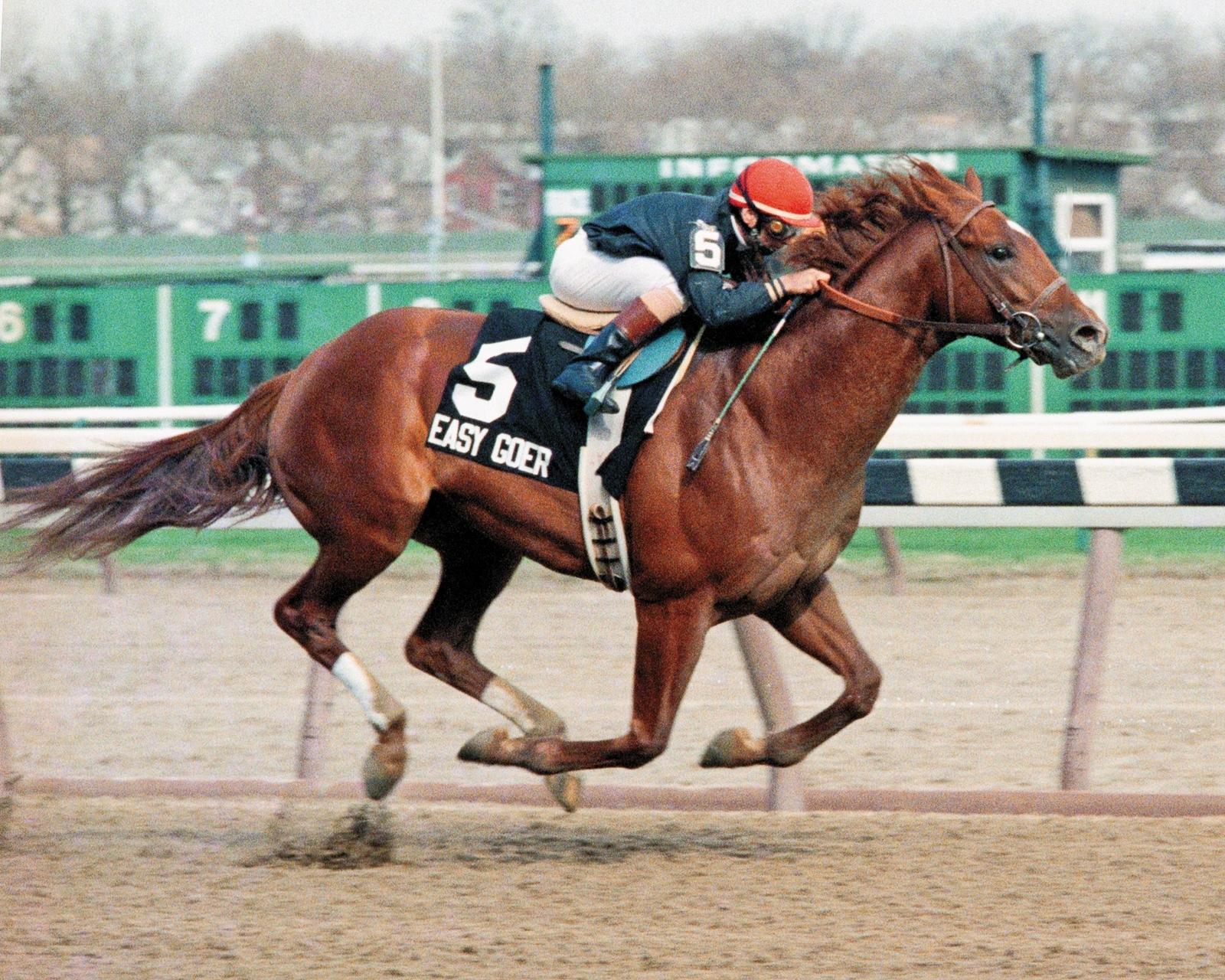
The field for the eight-furlong stakes was short – only four opponents – and bettors judged that none would come close to the favored Easy Goer, who left the starting gate as the overwhelming 1-20 favorite. With Pat Day in the saddle, he broke sharply from his outside post and moved up to second early before the Hall of Fame rider backed him off Diamond Donnie, the leader, and settled in fourth.
“I was just riding along with him, going with the flow,” Day said to Newsday’s Paul Moran. “and he was just gliding over the ground.”
The one-turn mile at Aqueduct came on a track that maintenance crew worked very hard Friday morning to prepare after rain the day before. The surface was very fast by Saturday and Easy Goer simply soared over the dirt surface. Day moved Easy Goer around the lone turn and by the stretch call they were 2 1/2 lengths in front. At the finish line, the margin was 13 lengths over Diamond Donnie, who was another 7 ¼ lengths in front of Expensive Decision.
The clock stopped at 1:32 2/5 for the mile, besting Secretariat’s 1:33 2/5 from his own Gotham win and breaking the track record by four-fifths of a second while only a fifth of a second of a second slower than Dr. Fager’s world record from 1968. Couple that record-breaking performance with his three-length win in the April 22 Wood Memorial, and it it was no surprise that Easy Goer went to the 115th Kentucky Derby as the favorite.
By 2005, George Steinbrenner’s New York Yankees had won the World Series six times (1977, 1978, 1996, 1998, 1999, and 2000) since his tenure as owner began in 1973. But that was not the sportsman’s only pursuit: he wanted to win a Kentucky Derby as much as he wanted another World Series and tried five times to win the run for the roses before his best try with his Kinsman Stable homebred Bellamy Road.
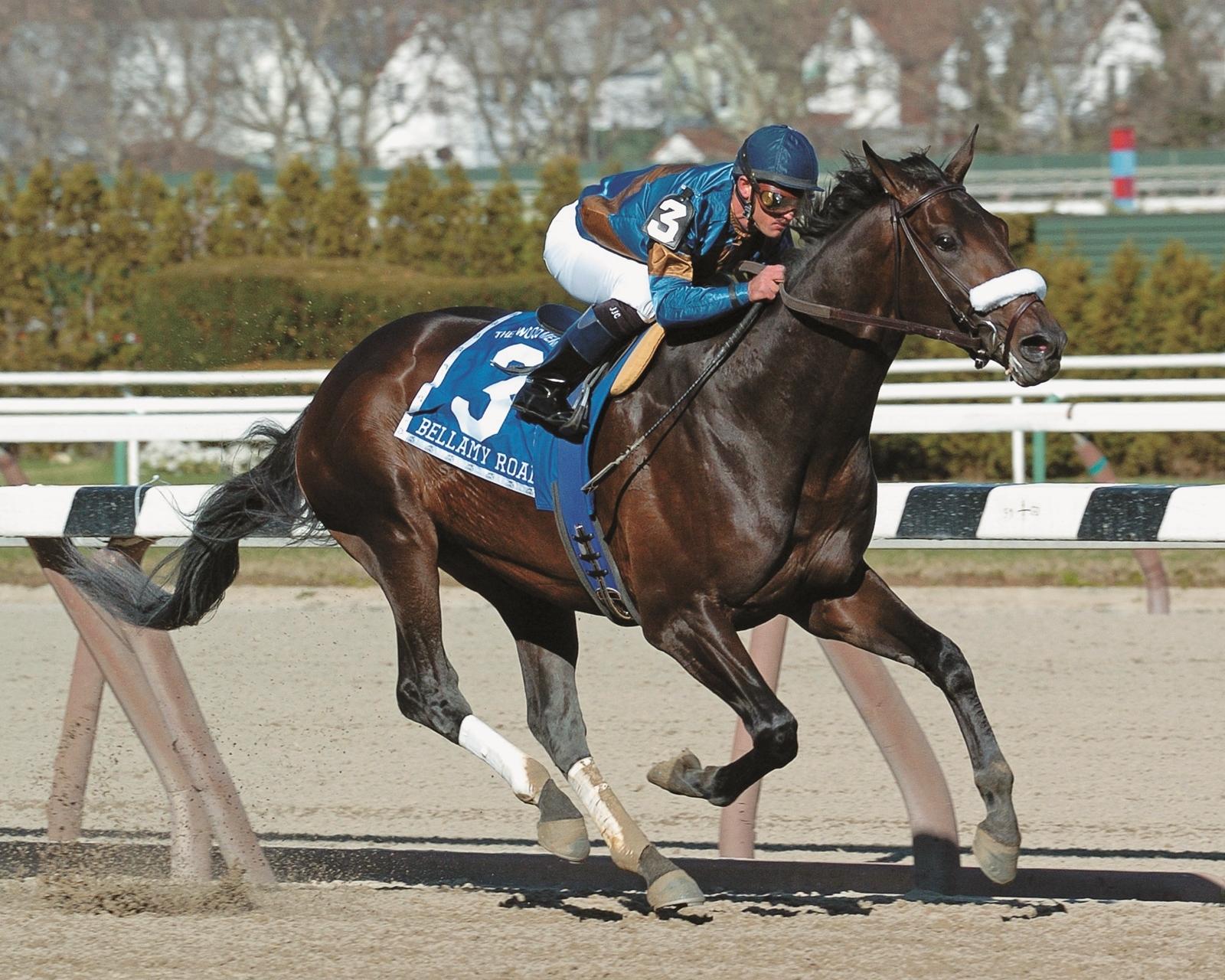
A son of Steinbrenner’s own Concerto, ninth in the 1997 Kentucky Derby, the dark bay or brown colt won his August 2004 debut at Delaware Park, and then won his next start as well, a 1 1/16-mile stakes at River Downs, now Belterra Park, in Ohio. He ran one more time at age 2, a seventh-place finish in the Breeders’ Futurity at Keeneland, before being transferred to Nick Zito’s barn at the beginning of his 3-year-old season. For Zito, he ran once at Gulfstream Park, winning a one-mile allowance race by an eye-opening 15 ¾ lengths. The trainer then sent him to Aqueduct for his intended prep race for the 131st Kentucky Derby, the Wood Memorial Stakes.
The field included Gotham Stakes winner Survivalist, graded stakes-placed stakes winners Galloping Grocer, Naughty New Yorker, and Going Wild, as well as Aqueduct stakes winners Scrappy T and Pavo. With Javier Castellano in the saddle, Bellamy Road broke from post-position No. 2 and immediately went to the lead, already 1 ½ lengths clear after the first quarter. Castellano let the colt cruise from there, Bellamy Road running easily on the lead.
“When Javier placed him where he placed him, you knew he was just going to go on and do business,” Zito told NYRA’s Christian Abdo in 2025. “When he hit three quarters in (109.84), I couldn’t believe the cruise control he was in. I said, ‘What is going on here?’ ”
At the top of the stretch, he was already well in front of Scrappy T, his advantage widening with each stride. Bellamy Road was 10 lengths in front in early stretch, the race’s outcome never in doubt. The only question was at that point, how much and how fast? At the finish line, the son of Concerto was 17 ½ lengths clear of runner-up Survivalist, his 1:47.16 a track record for 1 1/8 miles. That record-breaking performance sent him into the Kentucky Derby gate as the race’s favorite.
Though Bellamy Road would not realize Steinbrenner’s goal of a victory under the Twin Spires, his speedy performance at the Big A did earn him a spot on the list of the greatest performances this historic racetrack has seen.