


Tiznow, the Two-Time Breeders' Cup Winner and Beacon of Hope After Sept. 11

Horse racing has many different terms to measure margin of victory. Going from closest to largest, a horse can win by a nose, head, or neck, by fractions of a length, or by a length or more (a length is, as you might guess, the estimated length of a racehorse, roughly eight feet).
But sometimes, there is no margin to measure – the horses reach the finish line equally together. When that happens, the familiar term “dead heat” is applied, usually after a several-minute wait while the racetrack stewards examine the finish line photo.
Technology has come a long way over the past century, and a great leap occurred when the Southern California track Del Mar opened in 1937 with a slit-aperture camera to narrow down the finish line image. Now, digital cameras are used to obtain even more precise results, but of course disputes over photo finishes still occur quite frequently, usually initiated by persons who bet on the runner-up.
Dead heats result in payouts from the pari-mutuel pool being divided. Instead of receiving a full win payout of a horse you bet $2 on at 8-1 odds (getting roughly $18 back), you would receive a lesser amount depending on the post-time odds of the other horse that finished first along with yours. Payouts for finishing second (to place) are also divided based on odds. And any multi-horse bets involving the top-two finishers such as the exacta (first and second), trifecta (first, second, and third), and superfecta (add fourth) will have payouts divided and based on odds as well.
Horses can also finish in a dead heat for second, third, fourth, and any position in the race (although bettors only get paid for top-three finishes, i.e., win, place, and show). Purse shares for any dead-heat finishes are split 50-50.
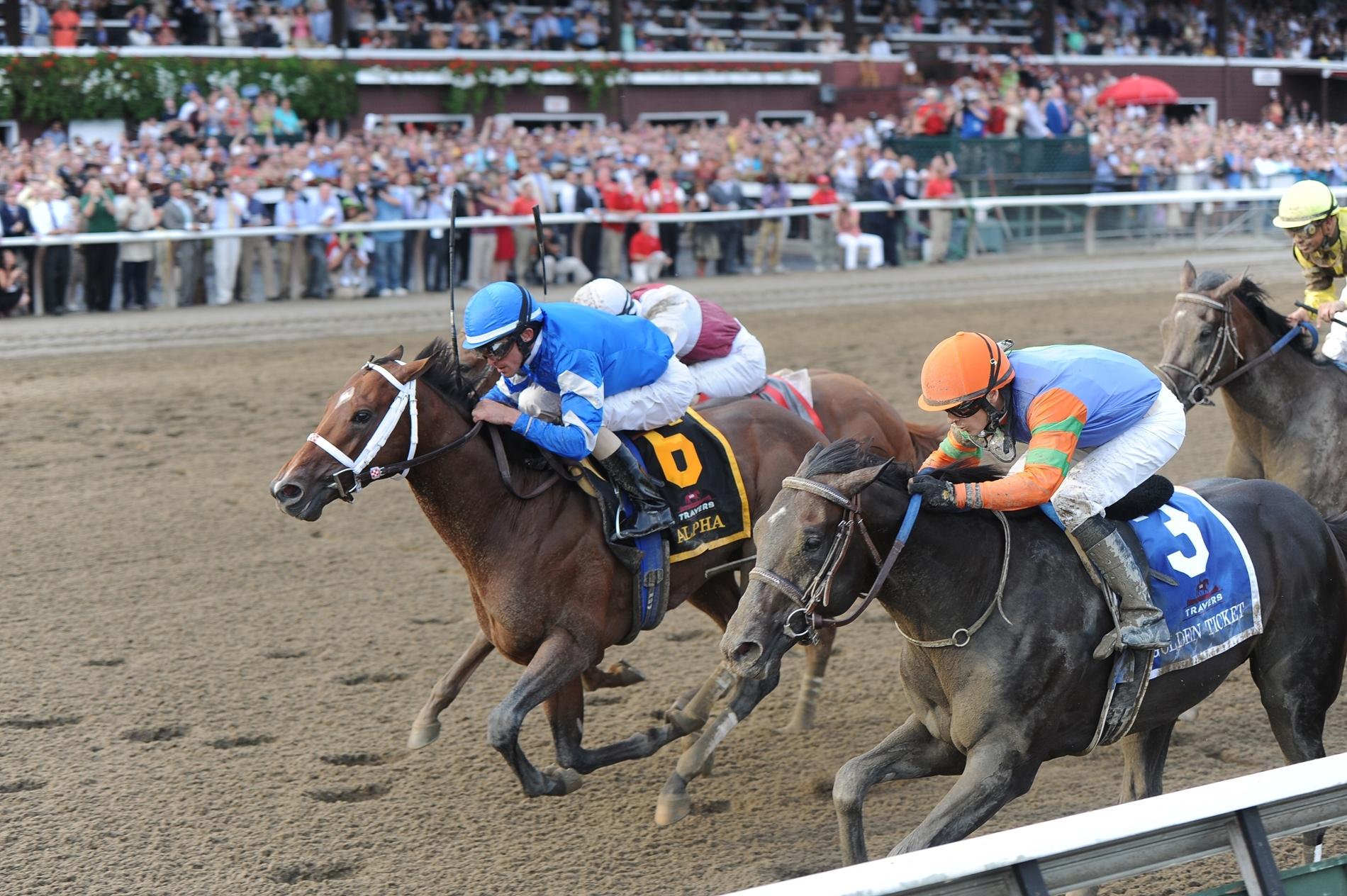
From a fan’s perspective, few things are more exciting than a dead heat in a horse race. There’s never been a dead heat for first in the Kentucky Derby, Preakness Stakes, or Belmont Stakes; however, there has been one in the Breeders’ Cup’s series of championship races, and that occurred in 2003 when High Chaparral and Johar could not be separated in the Breeders’ Cup Turf (and the third-place horse, Falbrav, was only a head behind the top two). Another recent dead heat of note occurred in the 2012 Travers Stakes, the prestigious “Mid-Summer Derby” at Saratoga, when Alpha and Golden Ticket split the winner’s purse. And last spring at the Keeneland Race Course in Kentucky, Expensive Queen and Segesta dead-heated for first in the Jenny Wiley Stakes, a prominent turf race for fillies and mares. Both added a Grade 1 victory to their respective résumés.
Have there ever been dead heats for first involving more than two horses? Yes there have, and as you might expect, they’re incredibly rare. Only one “triple dead heat” has been documented in a stakes race held in the U.S., and that came at Aqueduct Racetrack in New York way back in 1944. Three runners reached the finish line together in the Carter Handicap held at seven-eighths of a mile – Brownie on the inside, Bousset in the middle, and Wait a Bit on the outside. Pari-mutuel pools for win, place, and show were divided based on odds, and purse for all three spots was split three ways.
As a phrase, dead heat is used beyond the world of horse racing, common in sports such as track and field and swimming, in auto racing, and in any competitive context where a finish line or end point is set. It’s even used in politics, where you’ll hear pundits remark on a “near dead heat” or “virtual dead heat” when candidates in an election are separated by a handful of votes.